

To Keep A Yamaha Waveruner Warranty Do You Have To Do Service At A Dealer?
The earth of Jet Skis and personal watercraft can seem daunting for those who are new to the sport.
Sales representatives for – and owners of – each watercraft brand will tell yous theirs is the best.
Nonetheless, it's worth noting that, in general terms, all 3 mainstream watercraft brands have enough of skillful points – and room for improvement.
The adept news is each Jet Ski or personal watercraft brand generally has first-class reliability – as long as they are properly maintained according to their individual service schedule.
As with cars, sometimes things can go incorrect. However, trivial issues are rare in the Jet Ski and personal watercraft world, and problems are usually fixed every bit a running modify, during routine maintenance, or before the watercraft is delivered.
So while you lot may hear horror stories about diverse brands, it's worth asking yourself if that particular Jet Ski or personal watercraft was properly maintained – or was it driveling or neglected, or not serviced correctly?
The reality is all iii mainstream brands – Sea-Doo, Yamaha and Kawasaki – have advantages and disadvantages over their rivals.
In general terms, Body of water-Doo watercraft accept enviable user-friendly ergonomics and efficient engines, Yamaha Waverunners have above average handling in rough water and intuitive handling in flat water and medium chop, and Kawasaki has heavy duty, durable hull designs.
Equally this article was published, the standard factory warranties across all 3 brands varied: Sea-Doo (two years), Yamaha (three years) and Kawasaki (five years). These terms can modify during special promotional periods, then be sure to cheque.
However, the warranties are but every bit good as the condition and routine maintenance of each Jet Ski or personal watercraft.
While you are not compelled to service within the dealer network – and many owners service watercraft themselves or use independent mechanics – there are advantages of having a certified dealer perform routine maintenance.
Authorised dealers are constantly notified of whatever updates, running changes, role number changes, and warranty issues for each watercraft.
While there are some excellent independent mechanics, details on running changes or recalls are non immediately conveyed to technicians outside the dealer network.
In that location is also the advantage of selling your Jet Ski or personal watercraft with a log book dotted with dealer service stamps. It gives the next owner peace of heed, and hopefully makes your arts and crafts more appealing to would-be buyers than a machine that has not had proper maintenance.
With all this in mind, nosotros accept listed some of the known issues that have been flagged – and addressed – with the recent crop of Body of water-Doo, Yamaha and Kawasaki Jet Skis and personal watercraft.
Nosotros have sought to cut through some of the misinformation – and consulted experts in the field to embrace-off some of the bug that have been identified with each of the mainstream brands.
Information technology's worth noting, these are worse-example scenarios – and not indicative of every Jet Ski or personal watercraft sold by each brand.
Please practise not let this information discourage yous from purchasing a Jet Ski or personal watercraft. We are only trying to place some of the problems that accept affected each brand in the contempo past. In almost cases, the issues have been addressed.
This data is based on the experience of technicians who service and pre-evangelize hundreds of Jet Skis and personal watercraft across all three brands each yr.

Sea-Doo
Bounding main-Doo watercraft take splendid ergonomics and blueprint. Their user-friendliness and full general functionality are the envy of the industry.
Some common complaints include concerns well-nigh carbon seals which, if worn prematurely, tin cause the hull to have on water.
All the same, the issue is not as widespread as you may be led to believe. Proper maintenance volition minimise the chance of a fault developing.
Sea-Doo has used carbon seals on its flagship models since the late 1990s.
A carbon seal is a small, chamfered ring (similar in size and shape to the bottom of a soft beverage tin) made out of a carbon-graphite composite material that fits effectually the driveshaft.
Information technology presses tightly against a metallic band (shaped similar a top chapeau) to ensure the craft doesn't take on water via the small opening in the hull the driveshaft pokes through.
Because the driveshaft extends from the engine and through to the jet pump impeller on the underside of the hull through a pocket-size hole, the carbon seal is designed to provide a water-tight seal and prevents water from entering the engine compartment. It relies on friction to proceed the h2o out.
When a craft is well maintained, the carbon seal should never be a concern.
However, it's worth noting a carbon seal is a serviceable detail, much like brake pads on a machine.
A carbon seal tin can wearable prematurely if the driveshaft becomes out of alignment (such every bit due to engine mount failure equally a result of passenger abuse or severe wave jumping), or if the engine runs for an extended period of time while the craft is out of the water.
This is why Ocean-Doo advises to flush its watercraft for a maximum of xc seconds to ii minutes. Running the engine for longer than this while the craft is out of the water can damage the carbon seal if it gets likewise hot. When that happens, the seal is no longer water-tight and the craft tin start to slowly take on water.
Yamaha and Kawasaki instead use two-piece driveshafts connected via a condom coupler inside the engine compartment. The first half of the driveshaft is connected to the engine and links (via the coupler) to the second half of the driveshaft, which pokes out of the engine compartment and drives the jet pump impeller.
The engine compartments on Yamaha and Kawasaki watercraft are kept water-tight past a double-lip seal that goes around the driveshaft in a hole in the "firewall" (the structure between the engine bay and the underside of the arts and crafts).
Some Sea-Doo specialists recommend changing the carbon seal every 100 hours, although this is rare and replacement at this phase could exist caused by premature vesture and tear.
Body of water-Doo experts we spoke to said the carbon seal should exist inspected at each routine service – and checked for excessive wear or wobble on the support ring.
Our experts say a Sea-Doo carbon seal is more than likely to be replaced every four years or so – as a preventative measure – if it is wearing at a normal rate and the watercraft has not been abused.
Proper maintenance – and thorough checks during routine servicing – will help ensure you're not stranded during a day on the water.
Nigh carbon seal malfunctions can exist traced to incorrect maintenance – such as owners flushing their watercraft for also long when it is out of the water (the carbon seal gets too hot and wears prematurely, creating a gap for h2o to seep through).
At that place was briefly a batch of carbon seals produced in 2019 that weren't made to original manufacturer specifications. The supplier of the carbon seal changed, and switched to a new fabric, and this led to premature wear and – eventually – slow leaks.
It transpired the material was too soft, and Australian customers were first to feel the issue – because the offset batch of watercraft with the new carbon seal was sent to Australia. This is where many of the rumours stem from.
Yet, Bounding main-Doo dealers in Commonwealth of australia flagged the outcome with BRP head office, and Sea-Doo immediately reverted to the original supplier.
This is now regarded as a non-outcome by Sea-Doo, as all potentially afflicted watercraft had their carbon seals replaced, in many cases before customers took delivery.
Broken engine mounts can also lead to premature carbon seal habiliment. Yamaha and Kawasaki watercraft have 4 engine mounts; near Sea-Doo models have three engine mounts, ane of which can pause after astringent wave jumping.
When an engine mount breaks, information technology may not be obvious to the passenger, but the carbon seal can offset to habiliment prematurely equally the driveshaft is not properly aligned.
Body of water-Doo has since switched to a new, larger carbon seal 'lid' (or 'floating' metallic ring), which means it takes longer for the carbon seal to reach its overheating point.
Nevertheless, Sea-Doo experts say it's imperative the right part is used for each model. The part numbers sometimes have a deviation of only one digit – just 1 volition fit perfectly and 1 won't.
Sea-Doo experts say if the driveshaft is non aligned properly, it tin start to grate on the seal and create dust, which acts like sandpaper and accelerates wear.
Sea-Doo experts say the driveshaft must be perfectly aligned – left and correct, up and down, backwards and forrad.
Over fourth dimension, the engine mounts can slip forrard – even past just a few millimetres – and that can reduce the water-tight force per unit area on the carbon seal.
Rather than a carbon seal, Bounding main-Doo Spark and Spark Trixx models made from 2014 to 2020 accept a rubber seal (every bit per Yamaha and Kawasaki), and a splined driveshaft goes directly into the back of the engine.
The Bounding main-Doo Spark and Spark Trixx made from 2014 to 2020 use a condom seal (rather than a carbon seal) because the smaller and lighter engine doesn't move around as much under acceleration as the more powerful Sea-Doo engines.
It is worth noting Sea-Doo equipped the 2021 Spark Trixx with a carbon seal then the driveshaft splines remain lubricated, avoiding corrosion in that area.
Interestingly the Sea-Doo Spark and Spark Trixx have four engine mounts, which also aid with stability around the safety or carbon seals.
Whichever Ocean-Doo you lot own, experts say it's important to get into the habit of not flushing Sea-Doo watercraft for too long when they're out of the water.
Tardily model Ocean-Doos take a warning label near the hose plumbing equipment, advising owners not to flush the watercraft for longer than two minutes
For more detailed advice on flushing, delight see our guide hither.
Sea-Doo's airtight loop cooling arrangement means there's coolant recirculating through the veins in the ride plate, using the water under the craft to help cool the engine when running at speed – without table salt water or fresh water entering the engine.
In essence the ride plate acts as a radiator. There are unsubstantiated reports of ride plate corrosion, however Sea-Doo experts we contacted say they take not seen any examples of this, and suspect it's a scare tactic to discredit Sea-Doo'southward closed loop cooling system (Yamaha and Kawasaki use open up loop cooling systems, using the fresh water or common salt h2o you're riding in to cool the engine).
In early 2021, Body of water-Doo introduced a debris removal system known as IDF (intelligent droppings-free) on sure models which was, in effect, a "reverse thrust" organisation to clear droppings such as plastic bags from in the intake grate.
A number of Sea-Doo watercraft equipped with this tech – function of the initial batch sold globally in early 2021 – experienced failures which left them stranded without forward or reverse ability within the first few hours of operation.
However, Sea-Doo says the fault only afflicted a small number of watercraft with IDF and it has made meaning hardware changes to address the issues. Read about the running changes to Ocean-Doo's IDF tech in detail here.
Another concern around sure Ocean-Doo models is their Polytec (or plastic) hulls. Critics say this material is more hard to repair than fibreglass (Yamaha and Kawasaki), and colours are harder to friction match when a repair has been made.
Still, Sea-Doo experts insist this is non the instance. They say the Polytech 2 hull on the 2020 Sea-Doo GTI and GTR models, for example, have thicker hull sections and reinforced fibreglass sections in central areas, to ensure forcefulness and torsional rigidity and so the hull maintains its shape when cornering and in chop.
Sea-Doo experts say repairs to Polytech 2 hulls are much easier than repairs to fibreglass hulls. "They can withstand severe punishment from beingness dragged up the sand when beached," said 1 Body of water-Doo expert.
Nonetheless, experience with surf life-savers has shown that fibreglass hulls have the well-nigh resilience to "beaching", alee of Sea-Doo's Polytec material and Yamaha's NanoXcel, which is the nigh vulnerable in such scenarios and ideally should not be beached.
I Sea-Doo expert claimed information technology is quicker to repair a Polytec hull than a fibreglass hull.
"If you brought your damaged (Polytec hull) to me, we could repair it in-house and have it out the door in a day or so," said another Body of water-Doo adept.
"We weld them with the exact same material that they are made from, then the colour match is the aforementioned, apart from sun aging. A fibreglass (Jet Ski or personal watercraft) would be in the shop for three to four weeks."
The Body of water-Doo expert said: "The reality is, Polytech is lighter, more resilient, provides a better power-to-weight ratio and therefore better fuel economy. They take been making car parts out of this material since the 1980s."
However, the Sea-Doo expert did admit: "Fibreglass has a better finish, looks more premium and can be painted to lucifer any colour."
It is advisable not to operate any blazon of personal watercraft in a water depth of less than genu height, even when idling near the shore.
At speed, it is best to accept at least three-feet – close to 1 metre – of h2o depth as an absolute minimum.
Nonetheless, in our experience, Sea-Doo watercraft are more vulnerable to damage from sucking up sediment in shallow h2o, which can damage the plastic article of clothing ring.
Yamaha WaveRunners and Kawasaki Jet Skis don't take a wear ring. Instead, on those watercraft, the impeller has a touch on more clearance between it and the impeller housing.
Kawasaki Jet Skis have a stainless steel liner inside the jet pump housing, just the liner can't be replaced. Experts say a whole new jet pump housing is eventually required after two or three impellers have been replaced over an extended catamenia of time.
Because of this slightly extra clearance – compared to Ocean-Doo – Yamaha and Kawasaki watercraft tend to cope a petty better in shallow water, however they take chances damaging the impeller instead, which can exist a more than costly repair.
The slightly larger gap between the impeller and impeller housing (compared to the tighter clearance betwixt the metal impeller and plastic wearable ring on Sea-Doo watercraft) ways Yamaha WaveRunners and Kawasaki Jet Skis tend to 'cavitate', or struggle with intermittent 'thrust' when accelerating rapidly from a continuing starting time.
Sea-Doos tend to accelerate more than quickly and more smoothly from a standing start because of the minimal – almost zero – gap betwixt the metal impeller and plastic wear band.
Sea-Doo chose to install a plastic wearable ring because it tends to have the burden of the damage from any sediment sucked up in shallow water – rather than dissentious the impeller.
As with the carbon seal, a Sea-Doo plastic wear ring is a serviceable particular.
Some aftermarket suppliers offer metal wear ring replacements, however Sea-Doo does not recommend this because it could instead lead to impeller impairment.
To sum up: avoid shallow water in any personal watercraft, and especially in a Body of water-Doo.
If you lot damage a Sea-Doo clothing ring, you will notice the ski has intermittent 'thrust' and won't advance as smoothly from low speeds. Simply once upwardly to speed, it should easily maintain momentum unless the damage is severe.
You won't do any farther damage to a wear band by continuing to ride the craft – providing the water is deep plenty and clean enough – but it'southward best to get it replaced every bit soon as possible.
Finally, it's worth keeping an centre on the plasticnotches on the adaptable handlebars of ST3-based Sea-Doo models (such as the Bounding main-Doo Fish Pro, RXT-X RS300, and GTX Limited).
Because the top adjustment is locked in position via plastic steps or notches, the settings tin slip later on hitting a big wave, and lock the handlebars into the highest or everyman position.
It's difficult to rectify on the water, but it'south a quick fix at a Sea-Doo dealer who has the correct tools to reset the handlebars.
Plain Ocean-Doo has no plans to motility abroad from this plastic design. Yamaha and Kawasaki models with adaptable handlebars have stronger metal notches, which are non prone to skid out of position.

Yamaha
Although the well-nigh affordable Yamaha WaveRunner models use a heavy-duty fibreglass hull known as SMC (sheet moulded compound), a number of mid-range and top-finish Yamahas from 2008 to 2021 used a lighter hull material dubbed NanoXcel (from 2008) or NanoXcel II (from 2015), a form of lightweight sandwiched fibreglass.
Owners accept reported subtle hairline cracks in the hull surface and, in farthermost cases, delamination (where the paint peels away to expose the bare fibre-like material underneath).
Yamaha made running changes in an attempt to make its hull material more than robust, merely in our experience WaveRunners equipped with NanoXcel I or NanoXcel 2 hulls are more susceptible to damage – compared to other watercraft on the market – when used in open up-water conditions, and if they have been "beached".
Tiny scratches in the hull can atomic number 82 to bigger cracks. Our advice is to not beach whatever watercraft, regardless of make. You can read near ballast options here.
To properly address hull bang-up and delamination issues, from 2022 onwards the full-size Yamaha FX HO and Yamaha FX SVHO made a welcome return to heavy-duty SMC fibreglass hull material.
However the top deck of the 2022 Yamaha FX HO is still fabricated from NanoXcel 1 cloth, and the top deck of the 2022 Yamaha FX SVHO is yet fabricated from NanoXcel II textile.
From 2022, only the loftier-functioning Yamaha GP1800R SVHO and Yamaha JetBlaster models continue with NanoXcel.
Prior to the render to heavy-duty SMC fibreglass hull cloth, a number of known cases of Yamaha NanoXcel cracks occurred later on 50 or 100 hours of body of water riding, in the hands of experienced operators.
Yamaha was known to initially make repairs under warranty and, in some cases, it replaced watercraft nether Australian Consumer Law.
Yet, this is only after thorough investigation, and proof there was no mis-use or premature wear caused by "beaching" a ski or inadvertently damaging the hull on debris.
There is some concern in the industry around the repair methods of Yamaha's NanoXcel 1 and NanoXcel II textile, which could affect insurance premiums and insurance claims – because some arts and crafts may go written-off rather than repaired.
If you're wondering why surf life-savers are able to beach their Jet Skis and personal watercraft, that's because in nearly cases they have been fitted with a thick, adhesive hull protector forth the spine.
This tin can protect the hull to a certain extent, but it too affects treatment and high-speed functioning, which is why it is used mostly on surf life-saving watercraft rather than leisure craft.
In our experience, information technology is advisable to not "embankment" a WaveRunner equipped with a Yamaha NanoXcel and NanoXcel II hull. Also take intendance to avoid debris – and avoid riding the craft onto the trailer, which can beginning hairline fractures that can go worse over time.
Some Yamaha FX series models from 2019 onwards tin have fuel estimate accuracy problems, merely Yamaha has made running changes. Yamaha initially replaced fuel sender units and/or digital instrument displays to accost these concerns. From late 2020, Yamaha issued a 'version two' software update which is uploaded into digital instrument displays.
Helpfully, the FX series has a highly accurate fuel-used (by the litre) guess. Providing yous elevation-up the tank and reset this judge before each trip, you'll know exactly how much fuel you have used – and can then calculate what's left in the 70-litre tank.
The current generation (in particular 2019 and 2020 model-years) Yamaha FX series can be painfully slow to refuel, since Yamaha moved the fuel filler to the olfactory organ. A fuel force per unit area valve (in essence, a plastic tube) inside the fuel filler neck stops fuel from overflowing or "burping" when refuelling.
Some owners remove this part, which enables quicker refuelling. However, without the plastic "anti-burping" tube, y'all need to be careful to disengage the fuel filler cap slowly to release the congenital-up air pressure gradually.
For the 2021 model-year Yamaha FX HO and FX SVHO, Yamaha installed a new "anti-burping" tube near the acme of the fuel filler neck, which has largely alleviated slow refuelling issues.
A number of Yamaha FX HO riders have experienced fuel injector wire failures or fuel injector connector failures, usually after l to seventy hours of service.
I of the iv injector wires or connectors snaps, separates, or loses contact, and the engine will and so only run on three cylinders. It won't necessarily leave you stranded, but you won't be able to proceed at full speed.
In some instances, riding the watercraft in this condition – on three cylinders – for an extended period to return to a gunkhole ramp, can damage the engine management computer.
Bounding main-Doo mitigates the fuel injector wire separation issue past giving each pb enough wriggle room – and then securing each 1 with a cable tie so it doesn't split due to vibrate or fray almost the connector.
Yamaha besides ties or clamps excess fuel injector wiring, but some experts wonder if Yamaha needs to give the injector leads even more "wriggle room" – or if Yamaha needs to prefer a better quality connector, that tin handle the repeated movement of a watercraft in crude conditions.
If the watercraft is nether warranty, both the unabridged fuel injector wiring loom (or harness) and engine direction estimator should be replaced complimentary of charge, however there could exist parts delays.
Information technology's worth noting this issue is rare and seems to be exclusive to those who practice extended body of water riding in crude conditions.
A replacement fuel injector wiring loom (or harness) costs about $2800, nonetheless Yamaha is aware of this issue and this component is usually replaced under warranty, providing at that place are no signs of abuse, the watercraft is in standard status, and has undergone routine maintenance according to the logbook.
The fuel injector wire/connector consequence affects both the current generation FX HO 1.viii-litre non-supercharged engine, and the same engine in subsequently versions of the previous generation FX (from 2012 onwards).

Kawasaki
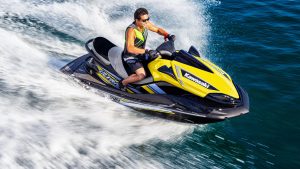
Kawasaki Jet Skis are known for having the strongest hulls in the business organization because they are notwithstanding made using old-school fibreglass, which makes them heavier than their rivals but more than durable and easier to repair.
The hull pattern of the Ultra has non changed since 2007, when the Ultra LX was introduced. Although the height deck for the STX160 was all-new for 2020, its hull has not changed since 2003, when it debuted on the STX-12F.
As the saying goes, if it aint broke, don't fix it. The most common feedback about the current range of Kawasaki Jet Skis is the operation of the large reverse lever on the left of the centre panel, rather than the more intuitive reverse triggers on the left handlebar of Sea-Doo and Yamaha models (on the opposite side to the accelerator trigger).
Bounding main-Doo introduced handlebar reverse triggers in 2010 and applied it to almost models in 2011. Yamaha applied handlebar reverse triggers to virtually models from 2015.
There is conjecture over who invented left handlebar reverse triggers for personal watercraft. Kawasaki experts merits Kawasaki designed a left handlebar reverse trigger before Sea-Doo or Yamaha, however others patented information technology get-go.
Kawasaki experts claim Kawasaki is developing a correct handlebar contrary trigger – under the throttle trigger – which is "thumb activated". If the arrangement goes into production, it ways the arts and crafts can be manoeuvred with one hand. Kawasaki experts claim the right-mitt reverse and accelerator trigger set-up is all the same in development.
Having tested all 3 types of reverse system, the Yamaha is the nearly intuitive because yous tin can activate it with i manus only, whereas the Body of water-Doo needs the throttle trigger to exist practical at the same fourth dimension, to make the reverse trigger piece of work with decent power.
The Kawasaki'southward existing contrary lever system is more cumbersome and requires more patience (and more skill) in low-speed manoeuvring.
Other Kawasaki notes: there have been numerous updates to the supercharged 1.5-litre four-cylinder used in the Ultra 310 introduced in 2014 – and in its previous guises including the Ultra 250 (2007-2008) Ultra 260 (2009 to 2011), and Ultra 300 (from 2011 in the US and from 2012 to 2013 in Commonwealth of australia).
Over time, Kawasaki has strengthened key internal components, such as the crank, cylinders, and head – and fitted a new Eaton twin vortices (TVS) supercharger that uses Kawasaki's ain adaptor (with an Eaton body), and a stronger timing concatenation (since the Ultra 300).
While the latest Kawasaki supercharger is a TVS blazon, the Ultra 250 and Ultra 260 had an erstwhile-school twin-spiral type supercharger, which sounded awesome but took a lot of power to drive it. The new supercharger provides ii litres of air per revolution.
The supercharged 1.v-litre engine from the Kawasaki Ultra 300 onwards is a completely new motor, although from the exterior information technology looks similar. Kawasaki experts say no major part from a 250 exists on an Ultra 300 or the current Ultra 310. However, the oil pumps on supercharged and non-supercharged Kawasaki Jet Skis take not inverse since 2004.
The near meaning changes to the Ultra 310 engine accept been new pistons with slipperier rings. The cylinders were changed to amend cooling and oil flow – and a knock sensor was added. Kawasaki experts say the Ultra 300 pistons are stronger, and Ultra 310 rings fit.
Kawasaki specialists say this goes some style to explaining why there were ringland failures on early Ultra 310 models. Still, experts say Kawasaki often replaces these even out of warranty – as long as the watercraft has been well maintained (serviced every 25 hours or annually, with muffler filters replaced as scheduled, as per the log book) and is in good condition.
Owners who service their watercraft themselves – or via an independent mechanic – may have difficulty in proving correct parts and oils were used for routine maintenance.
For now, Kawasaki continues to make running improvements to its Ultra 310 engine – the virtually powerful in the personal watercraft market place as this article was published – rather than undertake a consummate redesign.
Summary
It's worth noting that information technology is not up to the dealer to make up one's mind if a repair is covered under warranty. With all three brands – Sea-Doo, Yamaha and Kawasaki – the dealer must apply to the manufacturer for a warranty claim, on the customer's behalf.
If the watercraft has been well maintained and non abused, it's more than likely that known issues will be covered under warranty, even if you're but outside the warranty flow.
If the Jet Ski or personal watercraft has not been correctly maintained, repairs could be costly.
As the insight listed for all three brands above shows, no-one makes the perfect Jet Ski or personal watercraft – but it's helpful to know some of the background behind the rumours.
Delight proceed in mind the higher up examples are not indicative of most Jet Skis or personal watercraft – and are rare worse-case scenarios for each brand.
Each brand has its own strengths; it's a thing of which watercraft feels right for you – depending on your needs.
The cardinal message for whichever brand of watercraft y'all purchase: proper maintenance by experts in the business – and who specialise in your detail make of ski – are crucial to a trouble-gratis day on the water.
Let united states know if y'all take any tips or feedback: info@watercraftzone.com.au
MORE: All our Sea-Doo coverage in one click
MORE: 2021 Sea-Doo prices
More: All our Yamaha coverage in ane click
More: 2021 Yamaha WaveRunner prices
More than: All our Kawasaki coverage in one click
MORE: 2021 Kawasaki Jet Ski prices

To Keep A Yamaha Waveruner Warranty Do You Have To Do Service At A Dealer?,
Source: https://watercraftzone.com.au/myth-busters-the-truth-behind-the-rumours-about-each-brand/
Posted by: strouponer1953.blogspot.com
0 Response to "To Keep A Yamaha Waveruner Warranty Do You Have To Do Service At A Dealer?"
Post a Comment