

How Has The Internet Played A Role In The Sale Of Goods And Services?
The online mall helps people sort through product choice, but it is non the only method they utilize to appraise products and not a place where people oft shut the deal.
The internet is a valuable inquiry tool for online shoppers and at times provides information that is critically important in purchase decisions. Yet, mostly, purchases are consummated offline and mail service-purchase online commentary is merely a modest office of a typical shopper's activities. This is the role of the internet beyond three different products.
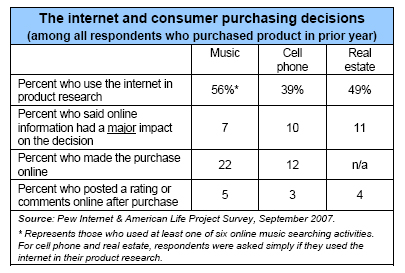
Additionally, the net is more often than not not the source people are most likely to utilise in the pre-purchase data gathering for these three products.
Among music buyers:
- 83% find out about music from the radio, Idiot box, or in a movie;
- 64% detect out about music from family unit, friends, or co-workers.
For cell phone purchasers:
- 59% ask an proficient of salesperson for advice;
- 46% go to i or more cell phone stores.
For people looking for a place to live:
- 49% look at ads in the newspaper;
- 47% ask a real estate agent for advice.
In this study, respondents were asked whether they had bought whatsoever of the three goods listed above in the past yr, and then directed to one of three question modules that probed their conclusion-making process. This enables analysis of consumer option for the three products along four dimensions:
- Search: How much people rely on the internet in product enquiry and to what extent online information smoothes the path to a purchase determination.
- Influence: Where the cyberspace's influence is peachy (or not) in consumer'south decisions.
- Participation: Whether net users get involved in online chatter or accept other steps after purchase to engage with what they bought.
- Disintermediation: Whether the internet serves as a fashion to become around traditional means (due east.g., going to retail stores) to buy products.
Following word of findings in these iv areas, the summary will get through the data on the three products that serve as the basis for the findings.
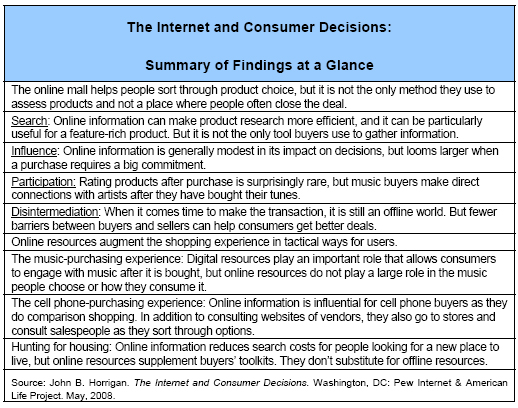
Search: Online information can brand production research more efficient and it tin be particularly useful for a feature-rich product. But information technology is non the only tool buyers use to gather data.
Information gathering is i of the most basic uses of the web and often the first footstep in consumer decision-making. It manifests itself in different ways for each of the products studied. Cell phone buyers face a wide range of choices amongst devices and service plans. Many of these choices are relevant to buyers, but at the same time information technology can be a challenge to sort through them. Thus, prison cell telephone buyers rely on different types of input – salespeople, websites of vendors, blogs, and review sites online – to help structure their determination. The demand for information is peachy in winnowing down the range of options, and the contractual commitment in many prison cell phone purchases adds to the demand for information.
For those looking for a place to live, the internet helps buyers focus their search. Real manor searchers face a lot of choices, merely not all of them may be relevant to their needs. The cyberspace helps shoppers reduce the number of properties that crave a trip to bank check out, as well as learn more about a transaction that has a high level of financial commitment.
The story for music is a bit different because information technology is an feel skilful – the kind of production whose quality is discernable only afterwards it has been consumed. This means that search has a lot to exercise with sampling. Internet users who are music buyers do this in a variety of ways – streaming songs to their computer, going to artists' websites, or watching music videos online. Because an experience good requires a lot of data-gathering to clinch the potential buyer the purchase volition exist worth the price, music buyers don't rely exclusively on the net in their search. In fact, they are more likely to rely on mainstream media or recommendations from family unit and friends for inspiration for music purchases.
Influence: Online information is generally modest in its impact on decisions, but looms larger when a purchase requires a big commitment.
No more than one-10th of buyers in each production category said that online data had a major affect on their purchasing conclusion. In conjunction with the finding that people use multiple sources, this suggests that the cyberspace is part of a competitive information surroundings in product research. Because people are willing to employ other sources for production research, this suggests online providers of production information take incentives to exist reliable every bit they reach out to consumers.
When the product in question requires a large delivery past a heir-apparent, the internet's influence on the option is greater. The cell phone, which ofttimes requires a contractual commitment, and real estate, which typically requires a large fiscal commitment, demonstrate this. Some x% of cell buyers (or 27% of those who used the internet specifically for enquiry on their prison cell buy) and eleven% of home buyers or renters (or 23% of those who used the internet for research on their real estate decision) said online data had a major touch on their purchasing decision.i Before making the purchase, internet users acquit all-encompassing online research and, for many, it makes a difference in their final decision.
For a good such as music – which involves less delivery but more difficulty in determining quality earlier purchase – online data competes with other sources as buyers search widely prior to buying. This lessens its influence on purchasing relative to the other products; but 7% of music buyers (or 12% of those who used the internet to discover out nearly music) said it had a major touch on their option.
Participation: Rating products after purchase is surprisingly rare, but music buyers make direct connections with artists later they take bought their tunes.
For each of the iii products studied, few said they had rated the product they had purchased. Among internet users in each product category, 6% of music buyers, 4% of prison cell buyers, and iv% of those who looked for a place to alive posted commentary most their experience on websites or blogs. Far larger percentages of online users in each category (about a quarter of music buyers, one-half of cell buyers, and a quarter of real manor shoppers) consult these sources in doing their search.
The large gaps betwixt contributors and readers are understandable; non all consumers are interested in lending their voice and many may exist content to free ride on the efforts of others. Notwithstanding, with the growth of broadband adoption at dwelling house and the buzz most online participation in a Spider web 2.0 globe, widespread action in this arena might be expected. Notwithstanding the information in this report practise not show this; in that location is clearly a distance between the numbers of those who contribute and those who lurk.
Music is somewhat different. Liner notes in albums used to be the well-nigh immediate style to learn something about a newly purchased album – potentially a conversation starter with a nearby friend. Now "digital liner notes" add a dynamic element to users' voices as they can create or monitor a variety of conversations about music. For music buyers, this often takes the form of reaching out directly to artists' websites (39% of online music buyers exercise this) or to similar-minded fans at blogs. Even though few music buyers charge per unit or comment on purchases, online resources such equally MySpace establish an agile participatory space online, especially for young adults.
Disintermediation: When it comes fourth dimension to make the transaction, it is nonetheless an offline globe. But fewer barriers between buyers and sellers can help consumers go amend deals.
The early visions of east-commerce – the "friction free commercialism" once touted past Beak Gates – saw producers and consumers transacting seamlessly. Cutting out the middleman would mean lower prices for consumers. But few buyers of music or cell phones execute the transaction online; almost rely on traditional retail stores.
While disintermediation conspicuously is non upon u.s., the report's findings propose that fewer communication barriers, both amongst buyers and between buyers and sellers, may benefit consumers. Sizable numbers of those who use the internet in product research for each of the three products study that they believe online information helped them get better deals. Amidst those who used the internet in product research:
- 42% of music buyers said online information helped them save money on music purchases.
- 41% of jail cell buyers said they spend less as a result of information they got online.
- 29% of those who used the internet in researching a new place to live said it helped get them a better price.
These figures suggest that, for some buyers, online information effectively improves their bargaining positions as they shop. There is, still, some other side to the coin; people say online information can prompt more than spending than might otherwise exist the case. Among music buyers who utilise the internet to notice out nearly music, 37% said the internet led them to buy more music than they otherwise might have. For cell buyers using the internet for product research, 43% said online information led them to get a phone with more features than they otherwise would accept.
Online resources broaden the shopping feel in tactical means for users.
Every bit useful equally online information might be in the shopping journey, users' reliance on multiple sources indicates that buyers apply the internet in tactical ways.
A music fan hears a song in a moving picture. That might prompt an online search to sample it, learn more almost the artist, or check out what others think of the song. Perhaps that results in a purchase of the song or the unabridged album; if and so, that'due south likely to mean a trip to the shop. Fifty-fifty for immature developed music buyers, whose purchasing path is more reliant on the internet, this basic pattern holds.
A real estate searcher might come across an advertizement for a identify in the paper or learn about information technology from a real estate amanuensis. That might spur an online search to learn more virtually it, and quite perchance save a trip beyond boondocks when the searcher finds the house or flat isn't for him. Or the online search might reveal a like place nearby, but offered at a lower price.
A cell phone heir-apparent may see an attractive new device in a store and ask some questions of a salesperson. Further online research might show the phone has features the heir-apparent may not use, but directly the search to a more than appropriate (and perhaps cheaper) device. Online data may make the difference in the final choice, simply in conjunction with offline queries.
In these examples, online information shapes the choice, perhaps even in important ways. As the information testify, however, the internet is not usually the major cistron that influences the terminal decision. This may exist partly attributable to some internet users concerns near online security in shopping, which discourages the use of online resources to shop.ii Nonetheless, the relatively modest influence of online information on shopping decisions as well has much to practise with people using multiple sources in their buying journey.
The music-purchasing experience: Digital resource play an important role that allows consumers to engage with music after information technology is bought, but online resources do non play a big role in the music people choose or how they consume it.
Music buyers seek out a wide range of resource as they recollect through the music they may want to purchase, but offline sources dominate. People are more likely to find out about music from traditional media or families, friends, or co-workers than from the internet.
- 83% of music buyers say they notice out about music from hearing a song on the radio, the tv, or in a movie.
- 64% say they detect out about music from friends, family unit members, or co-workers.
- 56% say they find out near music through various online tools, such as going to a band's or artist'due south website or streaming samples of songs to their computers.
Music buyers report that offline sources are more influential than the net in shaping their option of music purchases. When internet-using music buyers who used the internet for enquiry were asked to retrieve near the impact online resource had on their most recent music purchase:
- 51% said online information had no touch at all.
- 37% said online data had a minor bear upon.
- 12% said online data had a major impact.3
In general, 62% of music buyers who used the net to learn about music say an offline source mattered most compared to 32% who said something on the net made the nigh difference.
Music purchasing still more often than not ways ownership a CD and buying in a store.
- 82% of music buyers say that all (62%) or most (20%) of the music they purchase is CDs.
- fifteen% say at least half their purchases were individual digital files.
Even for immature adult music buyers (defined as those under age 36), music purchasing still is dominated by CDs (69% buy most or all of their music on CDs), with 27% purchasing digital music files at to the lowest degree half the time.
Every bit to point-of-purchase:
- 74% of music buyers say their most recent buy was at a store, while 22% said it was done online (either ordering a CD or a paid download).
Once people buy music, they are nearly likely to cite an offline ways equally a way that they share the experience, every bit 77% of music buyers say they talk about a music buy with family or friends. Various media resources besides play key roles in how people engage with music subsequently they purchase it:
- 56% of music buyers say they watch a music video of the song or artist, some of which may exist online videos.
- 44% of music buyers transfer the music to a CD, computer, or MP3 role player.
- 44% of music buyers have washed at least i online activity relating to their music purchase, such as going to an artist's or band's website or reading blogs about the artist or band.
Internet-using music buyers use the internet post-purchase to connect directly with artists.
- 39% go to the artist's or band's website.
- 28% look online for live performances by the creative person.
- 13% either postal service their music to a social networking site such as Facebook or mail service their ain reviews of the music they buy.
Mail service-purchase online activeness can encourage additional buying. Overall, 26% of net users who bought music in the by yr said online resource led them to purchase more music. Among cyberspace users who bought music in the past and who did at least ane mail-buy activity online, 40% said online resources led them to purchase more music.
The cell phone-purchasing experience: Online information is influential for jail cell phone buyers equally they do comparison shopping. In improver to consulting websites of vendors, they as well become to stores and consult salespeople every bit they sort through options.
Among those who take purchased a cell phone in the prior yr, here is how they did their research before the purchase:
- 59% asked an skillful or salesperson for advice.
- 46% go to one or more than cell telephone stores.
- 39% use the internet.
Amongst the two-fifths (39%) of people who use the internet for their groundwork research on a cell phone purchase:
- 76% go to website of jail cell phone manufacturers or cell phones.
- 59% use websites that compare cell phone features and prices.
- 50% consult reviews of cell phones on websites or blogs.
- 7% post queries in chat rooms or on listservs seeking information on jail cell phones.
When asked to think nearly the impact online resources had on their cell telephone purchase, here is what jail cell buyers who used the cyberspace in their research said:
- 46% said online data had a minor impact.
- 27% said online information had a major bear upon.iv
- 27% said online information had no touch on at all.
In general, 49% of prison cell phone buyers who used the internet in their research say an online source mattered most compared to 46% who said something establish offline made the most deviation. Fifty-fifty with the importance of online information, actual purchasing is an offline matter:
- 78% of prison cell phone buyers purchased their device in a shop.
- 12% of jail cell phone buyers bought their device online.
For cell phone buyers who employ the internet for research, it had a variety of impacts. Among the 39% of cell phone buyers who use the cyberspace for their background research:
- 48% said it changed the model or brand of cell phone they bought.
- 43% said online data led them to get a phone with more features than otherwise would take been the case.
- 41% said online information helped them spend less on their cell phone.
On balance, users are generally satisfied with the cell phones they buy. Three-quarters (78%) of prison cell buyers said they felt they had the correct amount of information in considering their purchase and 87% are either somewhat or very satisfied with the jail cell telephone they bought. Later people purchase their cell phone, postal service-purchase online chatter is minimal, as only 11% look online for information on how to use their telephone and 4% post a rating of their new device online.
Hunting for housing: Online information reduces search costs for people looking for a new place to alive, but online resources supplement buyers' toolkits. They don't substitute for offline resources.
People looking for a new place to live – especially those moving to a new city – rely very much on the internet for their real estate searching, just not to the exclusion of other means. Although one-half of real estate searchers start out past using the internet to get data, roughly the same share uses the newspaper or real estate agents. For those moving to new cities, the net is more heavily relied upon than it is for in-town movers, but so also is a real estate agent. Hither are the means people utilize when beginning the process of finding a new identify to live:
- 49% use the cyberspace.
- 49% look through ads in the newspaper.
- 47% ask a real estate agent for advice.
- 31% inquire friends, family members, or co-workers.
- fifteen% consult TV or radio.
For those who movement to a new city (53% of those in the sample looking for a new place to live), the internet is more heavily relied upon (lx%), but so is a real estate agent (55%).
Among those who moved in the prior twelvemonth and who used the internet in their housing inquiry:
- 58% say the information they got online helped introduce them to their new customs.
- 57% say it reduced the number of places they looked at.
- 29% say they idea online information helped them save money on the house they bought or apartment they rented.
Almost internet users who apply online resources in their housing search say that search has some influence the choice they somewhen make.
- 23% say information technology had a major impact on their housing decision.5
- 36% say it had a minor bear on.
- 42% say it had no impact at all.
After they take moved, the net is not widely used as a means to go acquainted with a new place:
- 5% discuss their new place or neighborhood in an online forum or community.
- 4% post comments or ratings online virtually real estate agents and others they dealt with in finding a place to live.
- 4% postal service comments most their new place or neighborhood on a website or blog.
- 3% join a neighborhood listserv.

How Has The Internet Played A Role In The Sale Of Goods And Services?,
Source: https://www.pewresearch.org/internet/2008/05/18/the-internet-and-consumer-choice/
Posted by: strouponer1953.blogspot.com
0 Response to "How Has The Internet Played A Role In The Sale Of Goods And Services?"
Post a Comment