

How Do Subroutines And Interrupt-service Routines Differ
adjacent → ← prev
Deviation betwixt ISR and Office Phone call
In this article, y'all volition learn about the deviation betwixt the ISR and part phone call, but before discussing the differences, you have to know about the ISR and function call in brief.
What is ISR?
An interrupt service routine (ISR) is a software routine that hardware invokes in response to an interrupt. ISR examines an interrupt, determines how to handle it, executes it, and returns a logical interrupt value. If no further handling is required, the ISR notifies the kernel with a render value. An ISR must perform very quickly to avoid slowing down the operation of the device and the operation of all lower-priority ISRs.
Although an ISR might move information from a CPU register or a hardware port into a retention buffer, mostly, information technology relies on a dedicated interrupt thread (or task), called the interrupt service thread (IST), to practise most of the required processing. If boosted processing is required, the ISR returns a logical interrupt value to the kernel. Then it maps a physical interrupt number to a logical interrupt value.
Mechanism of Interrupt Handling
Below is the mechanism of interrupt handling in the following steps, such as:
- An interrupt is a condition that makes the CPU suspend the electric current programme and execute an ISR. An ISR is a specially written plan to service the condition that caused the interrupt.
- After an interrupt is serviced, the CPU returns to the primary program, exactly at the next teaching where it had left.
- In interrupt-driven data transfer, whenever the I/O device is ready for the data transfer, it will interrupt the CPU. In the ISR, the CPU will perform the data transfer.
- This method is better than polling because the CPU does non have to waste fourth dimension in checking the status of the I/O device. A keyboard is a good instance of interrupt-driven I/O access.
- Instead of checking the CPU, the keyboard should interrupt the CPU when a key is pressed. Thus fourth dimension will non be wasted in repeatedly checking the keyboard when the user is not typing at all.
- The I/O device requests an interrupt past sending the $\overline{INTR}$ signal to the CPU.
- Whenever CPU receives $\overline{INTR}$ betoken, it completes the execution of the current instruction and then executes the ISR. When the CPU is ready, and so it sends admit betoken through the INTA line.
- ISR gets executed, and the CPU returns to the main program.
- I/O devices plow off the $\overline{INTR}$ signal after execution.
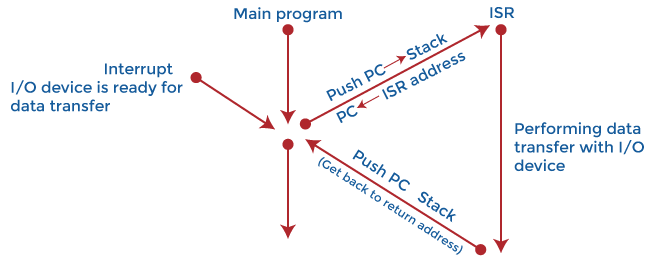
For Case: In the below example, I/O transfer by interrupt-driven I/O.
- If an I/O device that wants to perform a information transfer with the processor must interrupt the processor.
- An interrupt is a condition that makes the processor executes an Interrupt Service Routine.
- In the ISR, the processor volition perform data transfer with the I/O device.
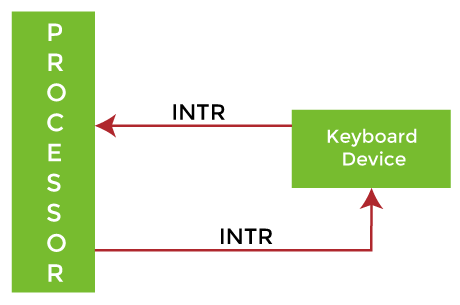
In this example, interrupt request by pressing the keyboard key,
- Instead of the processor checking whether a primal is pressed, the keyboard interrupts the processor when pressing a fundamental.
- In the ISR of the keyboard, which is a role of the keyboard commuter software, the processor volition read the information from the keyboard.
Advantages of ISR
Below are the following advantages of ISR, such as:
- ISR asynchronous events can occur at whatsoever fourth dimension during the program's execution.
- ISR saves the PC, Flags, and registers on the stack, disables all the interrupts, and loads the address of the ISR.
- ISR cannot have arguments that tin can exist passed to it.
- ISR cannot render values.
- ISR enables the interrupts.
- Generally, ISR is small as it takes another process's fourth dimension.
- Some of ISR accept their own stack.
What is Function Phone call?
A function telephone call is also called a subroutine call. A subroutine is a set of instructions needed repeatedly past the program. Information technology is function of a larger program that is responsible for conveying out a specific task. The larger plan may execute a heavy workload, and the subroutine may exist performing just a simple task, which is as well contained of the remaining program coding.
A part is coded in such a way that it may exist called multiple times and from different places (even from within other functions). When a role is called, the processor may go to where the lawmaking for the function is residing and execute the instructions of the function one by i. After completing the functions, the processor volition return to exactly where it left off and continue the execution starting from the adjacent instruction.
Functions are a great tool for lawmaking reuse. Many modern programming languages support functions. A collection of functions is called a library . Libraries are ofttimes used as means of sharing and trading software. In some cases, the whole program could be a sequence of subroutines.
In the case of an 8086 processor, a subroutine is invoked by a Phone call pedagogy, and control returns by a RET educational activity. Information technology reduces the size of the program.
Difference between ISR and Function Call
A office must be explicitly chosen and is office of the same context and thread of execution equally its caller. A hardware ISR is not explicitly chosen but rather invoked by some external outcome. The current thread's context is automatically preserved when an interrupt is called before switching context to the ISR.
In return, the opposite context switch occurs, restoring the state of the processor before the interrupt then that execution continues from the point of interruption. Beneath are some more than differences between ISR and office call.
| ISR | Role Call |
|---|---|
| The interrupt is usually initiated by an internal or an external indicate microprocessor rather than the execution of instructions. The ISR is executed after storing the program's current status in the stack. ISR performs different tasks depending on the interrupted device or instructions written by a programmer. | The function call is invoked by executing instructions, which perform the specific tasks and reduce the plan's size. |
| The hardware determines the accost of the ISR. The ISR accost is written inside the interrupt vector table, and the ISR address for each interrupt is fixed. | The address of the subroutine is written inside the instruction, which is written inside the principal program code. |
| ISR is used for all general-purpose tasks. | Function calls are made for program-specific tasks. |
| When an interrupt occurs during the execution of a electric current program, therefore, afterward the execution of the current teaching, the processor executes ISR. After the execution of ISR, the processor must resume the plan exactly equally earlier the interrupt occurred. For this, the PC content, µP registers, and some status conditions are stored. The collection of all status bit atmospheric condition in a microprocessor is called PSW (program status word).
| Here, simply a PC is stored on the stack to get the address of the side by side instruction in the main program. The subroutine must take access to data from the calling subroutine and render results to that subroutine. Therefore, subroutine parameters and information linkage is washed. This can be done through
|
Next Topic POSIX Threads in Bone
← prev next →

How Do Subroutines And Interrupt-service Routines Differ,
Source: https://www.javatpoint.com/isr-vs-function-call
Posted by: strouponer1953.blogspot.com
0 Response to "How Do Subroutines And Interrupt-service Routines Differ"
Post a Comment